






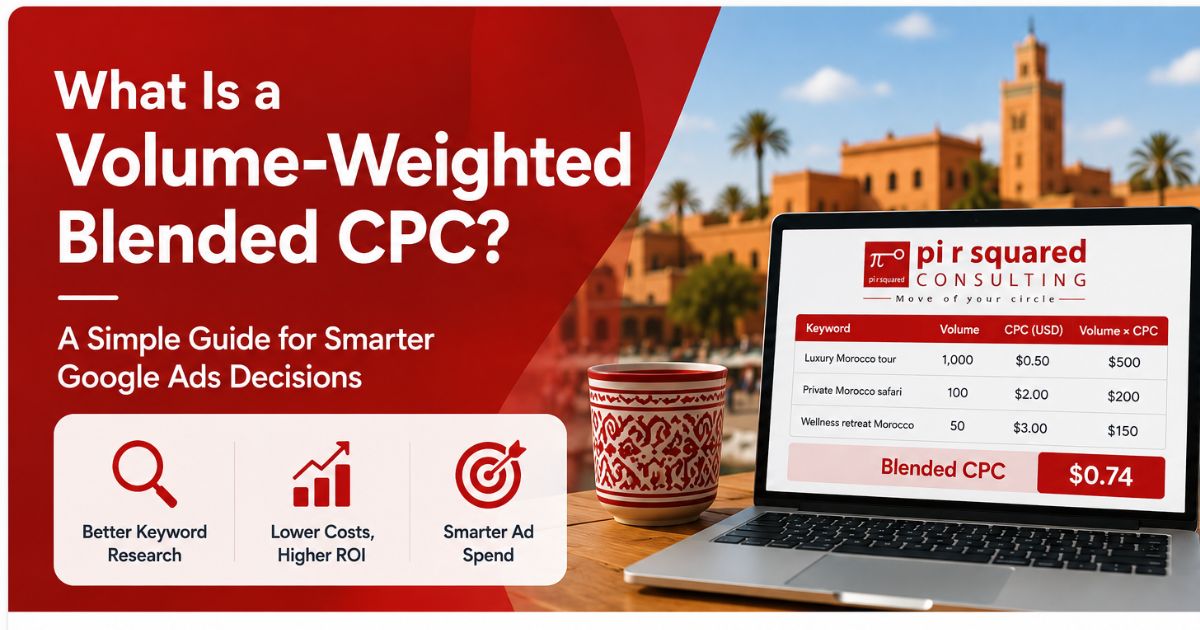
What Is a Volume-Weighted Blended CPC? A Beginner's Guide for PPC Marketers
If you've ever worked with Google Ads or keyword research, you've probably come across the term CPC (Cost Per Click). But when managing hundreds of keywords, especially for large PPC campaigns, another metric becomes much more important: Volume-Weighted Blended CPC.
At first glance, it sounds like a complicated marketing formula. In reality, it's simply a smarter way to estimate what you'll actually pay for clicks across an entire campaign.
Let's break it down.
What Is CPC?
CPC, or Cost Per Click, is the average amount an advertiser pays each time someone clicks on their Google Ad.
For example:
- Keyword A: Luxury Morocco Tours - CPC = $0.50
- Keyword B: Private Morocco Desert Safari - CPC = $2.00
- Keyword C: Morocco Wellness Retreat - CPC = $3.00
If you were looking at these keywords individually, their CPCs tell you how expensive each one is.
But what happens when you want to know the average CPC of all three keywords together?
The Problem with a Simple Average
Many beginners calculate the average like this:
($0.50 + $2.00 + $3.00) ÷ 3 = $1.83
Although the math is correct, the result is misleading.
Why?
Because every keyword is treated equally, regardless of how many people actually search for it.
Imagine these monthly search volumes:
| Keyword | Monthly Searches | CPC |
|---|---|---|
| Luxury Morocco Tours | 1,000 | $0.50 |
| Private Morocco Desert Safari | 100 | $2.00 |
| Morocco Wellness Retreat | 50 | $3.00 |
The first keyword receives twenty times more searches than the third, yet the simple average gives them exactly the same importance.
That's why PPC professionals rarely rely on a simple average.
What Is a Volume-Weighted Blended CPC?
A Volume-Weighted Blended CPC calculates the average CPC while giving more importance to keywords that have higher search volumes.
Instead of treating every keyword equally, it considers how often each keyword is searched.
The formula is:
This provides a much more realistic estimate of what your campaign is likely to cost.
A Simple Example
Let's use the same keywords.
| Keyword | Search Volume | CPC | Volume × CPC |
|---|---|---|---|
| Luxury Morocco Tours | 1,000 | $0.50 | $500 |
| Private Morocco Desert Safari | 100 | $2.00 | $200 |
| Morocco Wellness Retreat | 50 | $3.00 | $150 |
Total Search Volume: 1,150
Total (Volume × CPC): $850
Volume-Weighted Blended CPC = $850 ÷ 1,150 = $0.74
Your Volume-Weighted Blended CPC is $0.74, not $1.83.
This number is much closer to the actual average cost you can expect because it reflects how often each keyword is searched.
Why Does This Matter?
Imagine you're managing a Google Ads campaign with 200 keywords.
Some high-intent keywords may cost $3 to $5 per click because they're highly competitive.
Others may cost only $0.40 or $0.60.
If the lower-cost keywords have much higher search volumes, they help reduce the overall blended CPC of your campaign.
This allows you to include valuable premium keywords without dramatically increasing your average advertising costs.
Real-World Example
Suppose you're running Google Ads for a luxury travel company.
Your keyword list includes:
- Luxury Morocco honeymoon packages
- Private Morocco cultural tours
- Luxury Sahara Desert experiences
- Boutique Morocco wellness retreats
Some of these keywords may have high CPCs because they attract affluent travelers who are ready to book.
To keep the campaign profitable, you can balance them with high-volume, lower-cost long-tail keywords such as:
- Luxury Morocco tour 10 days
- Morocco private itinerary 2 weeks
- Morocco cultural luxury vacation
- Luxury Casablanca to Marrakech tour
This creates a healthier blended CPC while maintaining strong commercial intent.
Why Agencies Prefer Volume-Weighted CPC
Professional PPC agencies and Google Ads specialists use volume-weighted CPC because it helps them:
- Estimate campaign costs more accurately.
- Build keyword portfolios that maximize Return on Ad Spend (ROAS).
- Balance premium, expensive keywords with lower-cost opportunities.
- Plan budgets with greater confidence.
- Compare keyword groups more effectively.
Without weighting by search volume, campaign forecasts can easily become unrealistic.
Common Mistakes to Avoid
- Using a simple average instead of weighting by search volume.
- Ignoring keyword search volume entirely.
- Including informational keywords that are unlikely to convert.
- Mixing branded and non-branded keywords without analysis.
- Focusing only on low CPC while ignoring commercial intent.
A cheap keyword isn't always a good keyword. The goal is to find keywords that attract buyers, not just visitors.
Final Thoughts
Volume-Weighted Blended CPC is one of the most useful metrics in PPC planning because it paints a realistic picture of your expected advertising costs.
Instead of giving every keyword equal importance, it recognizes that keywords with higher search demand have a greater impact on your campaign's performance.
Whether you're researching keywords for Google Ads, estimating campaign budgets, or optimizing for better ROAS, understanding how to calculate a Volume-Weighted Blended CPC will help you make smarter, data-driven decisions.
In short, it's not just about finding cheap keywords. It's about building the right mix of high-intent keywords that keeps your advertising costs under control while driving profitable conversions.